Part 1 of this series can be found
here.
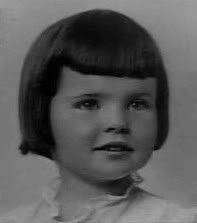
Compared to Clark Gable's childhood and upbringing, Carole Lombard's was almost fan magazine and publicist ready. She was born Jane Alice Peters on October 6, 1908 into a prominent Indiana family, the third child and only daughter of two parents who both descended from well-to-do families. Her father, Fred, was a golf and sports enthusiast; her mother Elizabeth, known as Bess, loved to attend theater, play tennis and put together social events, especially those for charities. In Fort Wayne, Fred and Bess were often mentioned in the local paper for their participation in tournaments and hosting various events for the community. Despite the united front, and possibly due in part to the separations necessitated by Fred's out of town travels for business and to participate in various golf tournaments, cracks would begin to show in their marriage.
 |
| Bess and her children |
Jane had a close and loving relationship with her mother, a woman she would grow to be very much like. Although she was younger than both of her brothers, she was protective of them and was later remembered to stick up for them on the playground and in the street. This strong will and feisty character would remain with her for life. She enjoyed a happy, relatively idyllic childhood, in spite of the continuing strain of her parents' marriage. Following Jane's seventh birthday, Bess and the three children left Fort Wayne in the fall of 1915. The quartet traveled to Los Angeles, ostensibly so that Bess could get a "rest," for a temporary visit. This is born out by local newspaper reports at the time, which stated the trip was an "extended holiday" and by Bess herself, who told her church that she would return in time for Christmas. Carole would later say that her mother planned for them to stay for six months; it seems the opportunities available and the far more agreeable weather, combined with the marital issues, led Bess to decide to make their move a permanent one.
Fred was apparently agreeable with Bess' decision. The two never divorced, remaining legally separated and apparently friendly, with Fred providing continued financial support, thus allowing the family to live in comfort and without much worry.

Jane had been a pretty baby and grew into a very pretty and confident tomboy. She was twelve years old and playing baseball with friends when Allan Dwan spotted her. Dwan was a director, producer and screenwriter; he had started his movie career on the east coast, as a scriptwriter for Essanay Studios, the studio primarily known for Charlie Chaplin's comedies. He would eventually operate Flying A Studios, one of the first motion picture studios in California and, in 1917, became the founding president of the East Coast Chapter of The Motion Picture Directors Association. By the time he first laid eyes on Jane Alice Peters, he had directed Mary Pickford, Douglas Fairbanks, Sr. and Gloria Swanson, among others, in successful films. Dwan was not a negligible Hollywood player by any means.
Dwan was preparing the film
A Perfect Crime and looking for a young girl to play the sister of actor Monte Blue. He fairly easily convinced Bess to let her daughter enter the movie business and accept the part. Jane took to acting naturally and as Dwan would later say, she "ate up the acting business." Bess, always happy to see her children happy, encouraged her daughter to cultivate her talents and look for further work - - although work did not materialize from the auditions the young girl attended.
 |
| A Perfect Crime |
It wasn't until she was fifteen, and at her school's May Day Carnival, that opportunity came knocking for her once again, this time in the form of a scout for Charlie Chaplin, who wanted actresses to screen test for
The Gold Rush. She didn't get the part but The Vitagraph Film Company saw her screen test, liked what they saw and debated offering her a contract on the stipulation that she change her first name as "Jane" was considered too dull. While the Vitagraph contract did not materialize, the teen did take their suggestion and adopt the first name "Carol," after a middle school classmate she had played tennis with.
In October of 1924, shortly before William Clark Gable made Josephine Dillon his first wife, sixteen year old Carol Peters was signed by Fox Film Corporation to her first contract. It's unclear exactly how this contract came about but it's been suggested that Bess contacted gossip columnist Louella Parsons, who used her insiders to arrange a screen test for Carol. However it came to be, Carol was signed to a $75 per week contract and officially called halt to her schooling in order to focus solely on her career. While Fox liked her new first name of Carol, unlike Vitagraph, they thoroughly disliked "Peters" and suggested that she take on a new surname. Her choice was Lombard, after a family friend.

The newly christened Carol Lombard enjoyed the photo shoots, costume fittings, socializing with actors on set and dancing at the Coconut Grove nightclub but she was less than satisfied with the early parts she was given at Fox. "All I had to do was simper prettily at the hero and scream with terror when he battled with the villain," she would later say. Lombard had her sights set on much better quality acting.
That chance would come in March of 1925 when she was given a leading role opposite Edmund Lowe in
Marriage in Transit. Her performance was well received, with Carol being singled out by reviewers. Before she or the studio could properly digest this, her career would be interrupted by a serious car accident in which she was thrown through a windshield. The impact, cutting her face from her nose to her cheekbone, would result in twenty-five stitches across her left cheek and under her left eye, leaving scars (but fortunately not affecting her eyes or eyesight.) To an actress, this was devastating as it could signify the end of her burgeoning career. Carol, however, had tenacity enough for a dozen. The doctor tending her did not use anesthetic while sewing in the stitches so that the facial muscles would not relax. Despite this, she was left with an angry, red scar and so she underwent a surgical procedure to lessen its visibility. While recuperating from the accident, Carol had busied herself by studying motion picture photography; now, she applied that knowledge to understand how certain lighting could lessen the appearance of her scar. She became an expert in the use of diffusing glass on the camera lens, enough to where she too could have become a cameraman or cinematographer. She also schooled herself on makeup applications and techniques so that she was a pro on her appearance.
 |
| As a Sennett Bathing Beauty |
Unfortunately. the studio heads at Fox displayed extremely poor hindsight and judgment in feeling that despite her excellent reviews in
Marriage in Transit, Carol Lombard had none of the qualities necessary to become a leading lady. They let her one year contract lapse in the fall of 1925. She would go without work for the next year.
In 1927, she obtained a screen test for Mack Sennett, known as the "King of Comedy," due to his slapstick Keystone Cops shorts, pie throwing, wild car chases and his success at making comedienne Mabel Normand a major star. Although Carol initially had reservations about performing slapstick, when she was offered a contract, she accepted, becoming one of the Sennett Bathing Beauties, joining such other future stars as Juanita Hansen, Marie Prevost and Phyllis Haver. Her initial concerns would turn out to be unfounded, as she greatly enjoyed her time at the studio. She would appear in fifteen short films between 1927 and 1929 and those films would give her invaluable experience into timing and comedy acting, something she would use to great advantage in the future.
 |
| Photographed by Edwin Bower Hesser, 1928 |
Sennett's films were distributed by
Pathé Exchange, who liked Lombard and put her in feature movies beginning in 1928. Her supporting roles in
Show Folks and
Ned McCobb's Daughter were singled out; the following year,
Pathé upgraded her from supporting player to leading lady. The three films that followed,
High Voltage,
Big News and
The Racketeer were all critical and commercial successes. Film Daily would state that Carol had "the stuff to go over."
 |
| Bill |
After a brief return to Fox in 1930 to co-star in
The Arizona Kid with Warner Baxter, Paramount Pictures recruited her and signed Carol to a $350 per week contract, gradually increasing to $3,600 per week by 1936. She was put in a comedy with Buddy Rogers, then at the top of his game and who, in 1937, would marry America's Sweetheart Mary Pickford, called
Safety in Numbers. She was singled out as an "ace comedienne," and then assigned to star opposite one of Paramount's biggest (and most temperamental) stars, Miriam Hopkins, in
Fast and Loose. Hopkins would later play an important part in Lombard's only film teaming with Clark Gable. For
Fast and Loose, Paramount mistakenly credited her as "Carole" and Lombard decided she liked this spelling better and kept it. Thus was born her third and final professional name.
Bigger changes were to come with the second and third films she would make for Paramount in 1931.
Man of the World and
Ladies Man would both feature Paramount's leading male star, William Powell.
Powell, a graduate of the American Academy of Dramatic Arts, had begun his career in vaudeville and stock companies. He had a success on Broadway before heading to Hollywood in 1922, where he would start off with small roles. He had married a fellow actress in 1915 when he was twenty-three; with her, he would have his only child, a son. While the marriage would not survive - the couple divorced in 1930 - Bill's career became highly successful following his appearance as detective Philo Vance in 1929.
 |
| The honeymooners |
Carole had been a fan of Bill's before they met, due to his debonair on-screen (and off-screen) personality and dashing good looks. It wasn't long before the two were in a relationship. They were an unusual pair; Powell was intellectual, sophisticated and sixteen years older than Carole, who was only twenty-two, wild and carefree. Bill was gentlemanly and studious while Carole possessed a notoriously salty mouth - something she had picked up from her older brothers, asking them to teach her curse words as a teenager in order to protect herself from men in the entertainment business who were less than upstanding.
Bill had been crazy about Carole, claiming he asked her to marry him every half hour until she agreed. His persistence paid off and the couple were married on June 26, 1931 in Beverly Hills. The new bride would tell the media that it was their differences that made them work, a "perfect see-saw" of compatibility. The Lombard-Powell marriage would bring a much higher level of fame to Carole although the marriage itself got off to a tricky start when she contracted influenza during their Hawaiian honeymoon that turned into pleurisy. She would battle illness for the first year of their marriage, hardly an ideal beginning.
 |
| At home with Bill |
Career wise, however, Carole was on a roll. She appeared in five films in both 1931 and 1932, pleasing critics who declared that she was well on her way to becoming a major star in her own right. She did suffer through two flops - -
No One Man and
Sinners in the Sun - - but rebounded with
Virtue and the adaptation of
No More Orchids, based on the novel by Grace Perkins, who had also written the classic
Night Nurse under the pen name Dora Macy (a film in which Gable starred with Barbara Stanwyck.)
It was upon completing
No More Orchids that Carole was cast in
No Man Of Her Own, in which she would play Connie, a small town librarian who becomes the wife of a gambler and con artist by the astounding name of Babe, who would eventually go straight thanks to her love (and maybe a little jail sentence). In an ironic and somewhat gruesome foretelling of future events in the real life of Carole, the characters of Connie and Babe decide to let a coin toss determine their future.
Carole narrowly missed out on this role as Miriam Hopkins, originally offered the lead, balked over co-star Clark Gable getting top billing and insisted on being given another project, thereby opening the door for Lombard.

Gable too nearly didn't get the project as George Raft was Paramount's original choice for the role of Babe. However, Marion Davies desperately wanted Bing Crosby for her next project,
Going Hollywood, and with a little encouragement from her benefactor, William Randolph Hearst, convinced MGM to make a trade of Gable for Crosby.
Gable was sent to Paramount to work on a film of his choice. With no projects in the pipeline at MGM, he leisurely looked over the available Paramount properties. The only script he cared for was the adaptation of the Val Lewton novel titled
No Bed Of Her Own. Paramount was not run by a bunch of dummies and despite Raft's popularity, Gable was the up and coming star and they knew they would be foolish to not let him take his pick of roles and so the part was his. The project would eventually be renamed
No Man Of Her Own, after obvious censorship concerns.
Director Wesley Ruggles, just coming off his huge success with
Cimarron, was tapped to helm the picture. He would later recall being impressed by the work of Lombard and Gable, especially during the first half of the film, where there was a great deal of romantic comedy. Clark, he would say, was "a damn sight light better comedian than he ever got credit for being." And Carole was a "revelation." Her work "didn't look like acting, it was so damn natural, so fresh."
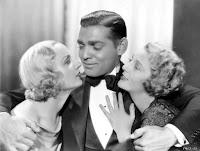 |
| Lombard, Gable and Mackaill |
By all accounts, neither Lombard nor Gable gave too much thought to the other on the set of
No Man Of Her Own. Both were smarting over loan out deals; Lombard had been loaned out by Paramount for her last two pictures, Gable by MGM for this film. Both studios were pocketing $500 per week for their actors' services and both Carole and Clark felt slighted that they were not receiving the full amount the "borrowing" studio was paying for their services.
Both were also married to others at the time; Carole was very much in love with Bill and busy being the happy newlywed, with no reports that she engaged in any outside interests. Other than her domestic life, she was single-minded with regard to her focus on her career. Gable, who surely by the end of 1932, when
No Man of Her Own was filmed, had a reputation for making time with his leading ladies on and off set, didn't bother trying with Carole. He had enough on his mind with his on-again, off-again affair with frequent co-star Joan Crawford and his less than ideal marriage and home life. Furthermore, he wasn't exactly sure he approved of his current leading lady's salty and colorful language, which was always on full audio display.
Despite their lack of romantic interest in the other, they had a good working relationship and friendly banter. Clark christened Carole with a nickname that would stick for life, calling her "Ma," something his film character did as well. She retaliated by dubbing him "Pa."

Co-star Dorothy Mackaill, who had the part of Gable's former mistress in the film, recalled that Clark showed up on set one day with a Hoover button - - Election Day was fast approaching and MGM was encouraging its stars to vote for Hoover. Carole, Mackaill said, ripped the button from Clark's lapel and told him to "shove it up L.B. Mayer's ass." Politics aside, you've got to love Carole.
On the last day of filming, Gable gifted Lombard with a pair of ballerina slippers, for the "true primadonna" of the set. She was no slouch and gave him a large ham with his picture taped to the label. Neither was offended by the other's gift and parted with a farewell kiss, on good terms.
It would take a third twist of fate, their paths crossing once again, at a Mayfair Club Ball to shake things up and shake them up in a major way.